


We have previously discussed the mathematics behind Quantum gates in depth, which is an important lesson to take before this one.

This week’s lesson is all about single-qubit quantum gates.
Let’s begin!
What Are Single-Qubit Quantum Gates?
Single-qubit quantum gates act and operate on individual qubits to manipulate their quantum state.
Each quantum gate represents the rotation of a point representing a qubit on the Bloch sphere.
Since there are infinitely many possible rotation axes and each axis can have infinitely many rotation angles, the space of all possible operations on a qubit is uncountably infinite.
Therefore, there are uncountably infinite single-qubit gates.
Some of these gates are more commonly used and hence named. We will discuss these gates in more detail next.
1. Identity Gate
This gate, when applied to a qubit, preserves its state or leaves it unchanged.
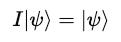
where the Identity gate is represented by I and the following matrix:
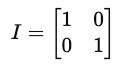
It is represented by the following symbol in a quantum circuit diagram:

For example, I applied to |0> returns |0>.
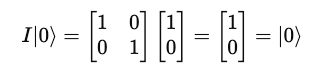
And, I applied to |1> returns |1>.
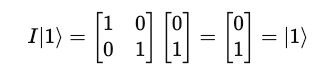
2. Pauli Gates
There are three Pauli gates are follows:
X-gate: which causes a bit flip (like the classical NOT gate) for a qubit state
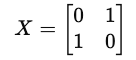
It is represented by the following symbols in a quantum circuit diagram:

or,

Y-gate: which causes a combination of a bit flip and a phase flip for a qubit state
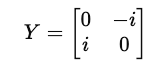
It is represented by the following symbol in a quantum circuit diagram:

Z-gate: which causes a phase flip for a qubit in the state
|1>but leaves|0⟩unchanged.
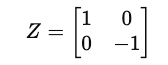
It is represented by the following symbol in a quantum circuit diagram:

We have discussed these gates in a lot of depth previously. In case you missed it, this lesson can be found here.

3. Hadamard Gate
This gate is used to create a quantum superposition state.
It is represented by the following matrix:
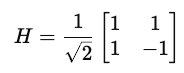
It is represented by the following symbol in a quantum circuit diagram:

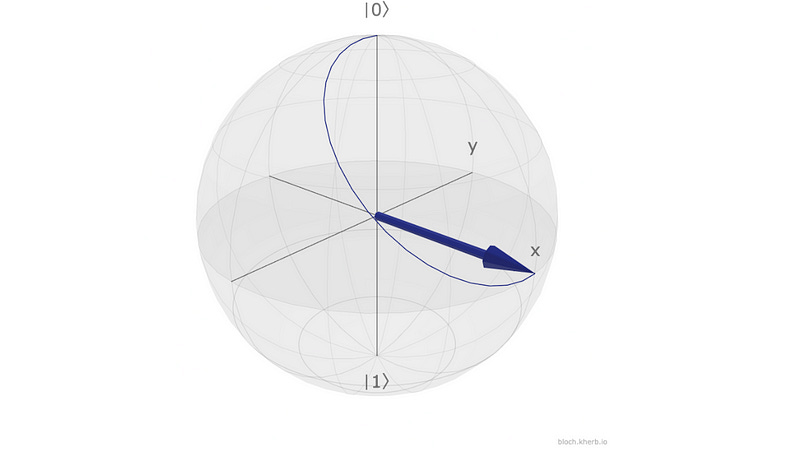
When H acts on |0>, it creates the following superposition state:

This looks as follows on the Bloch sphere:
And when H acts on |1>, it creates the following superposition state:

This looks as follows on the Bloch sphere:
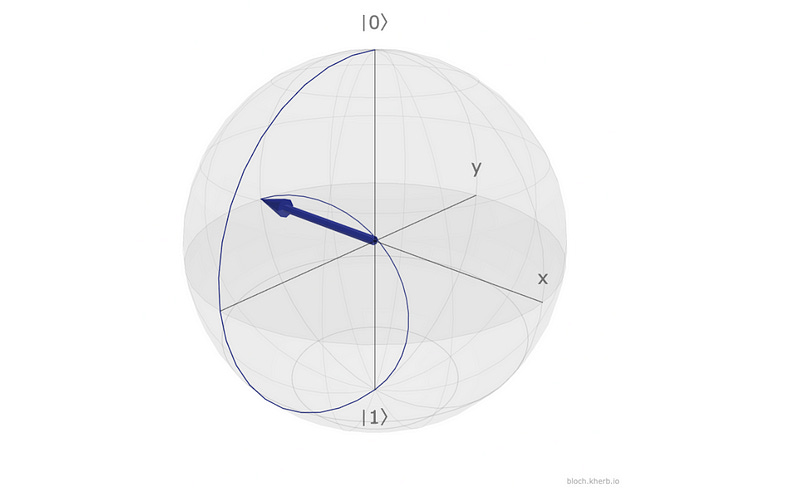
The resulting states are equal superposition states with opposite relative phases or a relative phase difference of π.
We have previously discussed applying the Hadamard gate to build a quantum circuit on a real quantum computer.
In case you missed this lesson, it can be found here.

This lesson on single-qubit gates is divided into multiple parts to keep it short and easy to grasp.
Thanks for being a curious reader of “Into Quantum”, a publication that aims to teach Quantum Computing from the very ground up.
See you soon in the next lesson!
